
Terry Lay worked as a display artist for fashion giant Famous-Barr during a golden era when downtown St. Louis was a shopping destination. Over a decades-long merchandising career, he witnessed firsthand how the art of window display changed as the retail industry evolved. Lay retired in 2008 and turned his talent to watercolor. His work has been recognized in area galleries, including Heartland Art Club, where he is a new member. Recently, he shared memories of his work in an art form that remains an indelible part of St. Louis history.
By Kara Dicker
It was 1966, and Terry Lay, a kid from Webster Groves, had just graduated from the University of Missouri-Columbia. Like many who studied fine arts at the time, Lay figured he would find work as a two-dimensional commercial artist, perhaps illustrating for a newspaper. A friend of a friend’s mother changed that trajectory.
“I met a girl in college whose mother worked in the art department in Famous-Barr,” Lay recalled. The woman was a friend of Sam Clark, the head of the company’s display department at the flagship store in the Railway Exchange Building in downtown St. Louis. Clark, who had previously worked for Saks Fifth Avenue, was new to the company, but his reputation for creative fashion and holiday window displays had already taken off.
Lay, who credits theatrical experience with giving him an interview advantage, was hired on the spot. “And that’s what I did for the rest of my life,” he said.
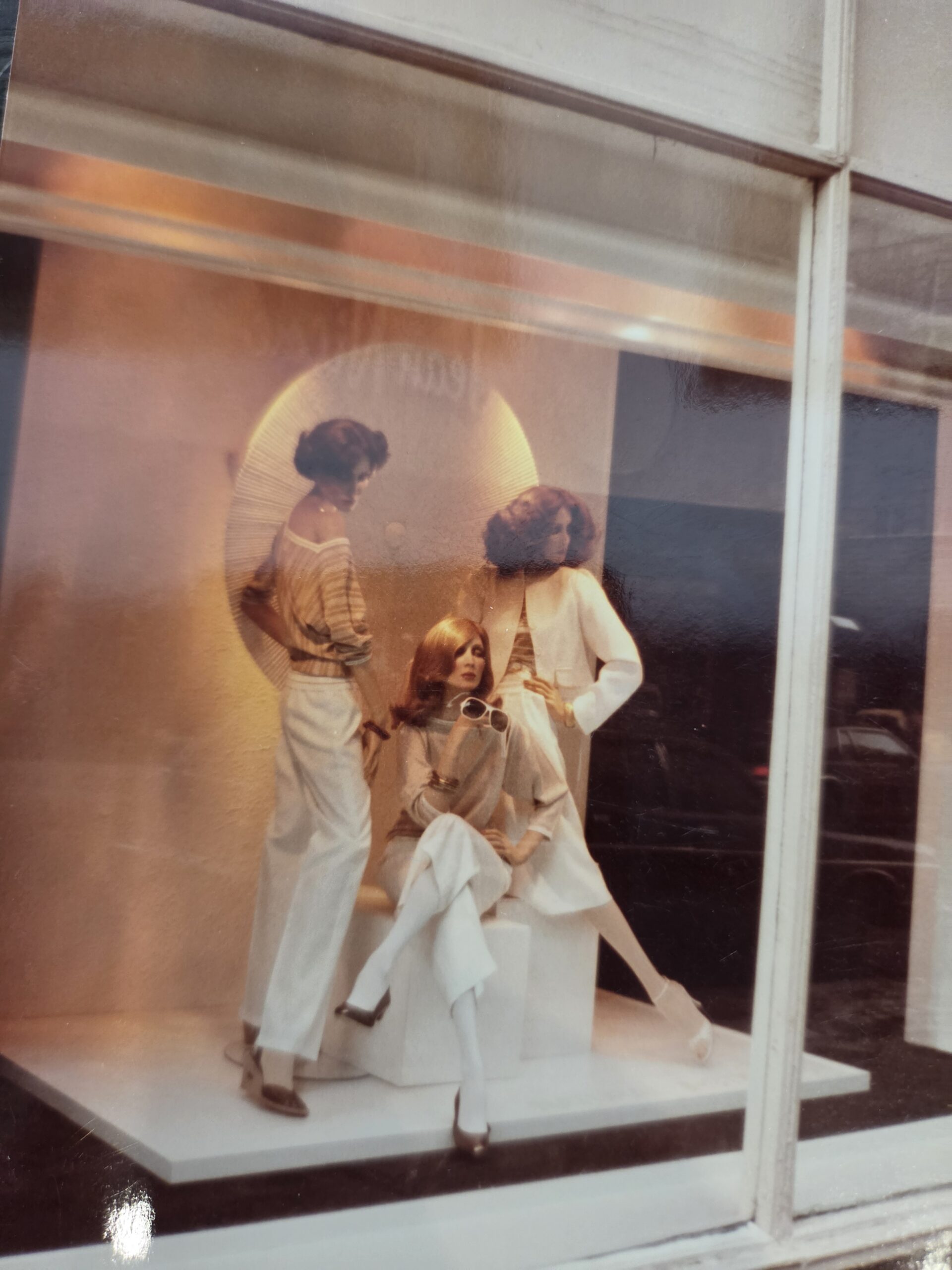
Display window at the downtown Famous-Barr, circa early 1980s. Photo courtesy of Terry Lay.
It was a golden era in the mid-century, when major department stores put a premium on ambience to engage the bustling pedestrian traffic of larger cities. Behind glass-enclosed displays was talent who understood the street dance designed to make one stop, look, and want.
“The windows were always made to entice people to come in,” Lay said. “The more amazing you could make them, the more people were amazed.”
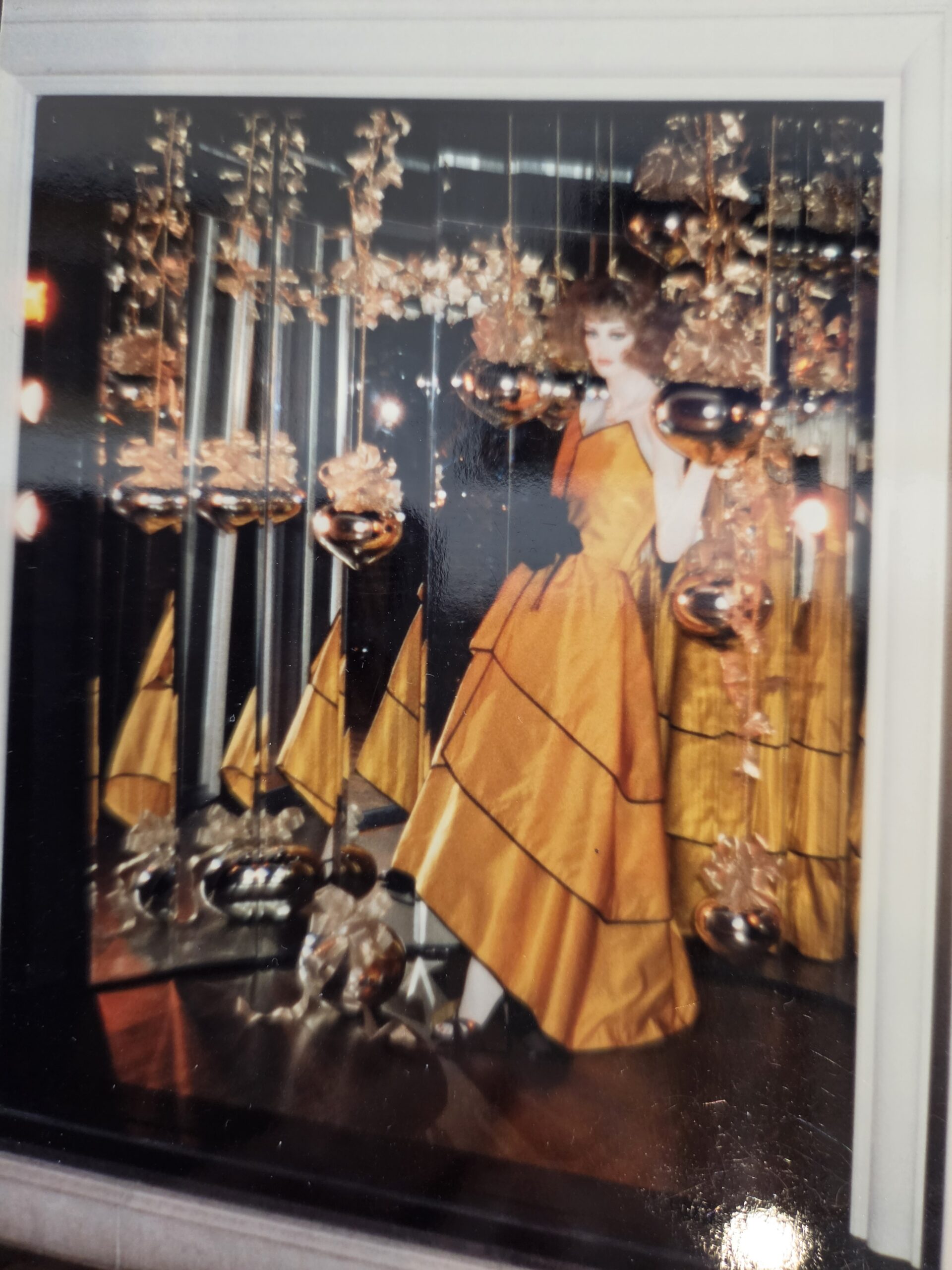
Dressed for the holidays. Photo courtesy of Terry Lay.
In New York City, before they were familiar names, Andy Warhol and Jasper Johns worked behind the windows of Macy’s, Tiffany & Co., and Bonwit Teller. In 1940s St. Louis, sculptor Ernest Trova was a window trimmer for Stix, Baer & Fuller and Famous-Barr, just long enough to develop the concept behind his mannequin-inspired Falling Man series, for which he later became famous.
When Lay came aboard in the late ‘60s, he joined the display department fleet of 35 to 40 personnel charged with changing the store’s 10 street-level windows along Seventh Street every two weeks. In addition to carpenters and electricians, the team included specialists in floral design, cosmetics, and silkscreen artistry. It was an apprenticeship atmosphere where Lay worked in home furnishings before moving up to women’s and men’s fashion
“You were with so many talented people with so many different skills,” Lay recalled. “The fact that you were a part of that was so gratifying. I loved going to work, even though the work was hard.”
Sometimes, the work was unexpected. Lay remembers a corner window display (Seventh and Olive) that featured an actual waterfall: “The whole window was filled with plants, and the floor was covered over in sphagnum moss. I don’t know how many gallons it ran, but it was quite a waterfall – a real showstopper. The only bad thing was that all the plants and water caused so much humidity that the windows fogged up. We had to go in there two or three times a day with squeegees to clear the windows.”
Clark, meanwhile, traveled to merchandising fairs in New York and abroad, returning with thematic promotional concepts that evoked international flair and for which he became known. Scandia was a promotion Clark directed in 1966 that celebrated furnishings in the popular Danish Modern style. “It also featured artisans from Scandinavian countries, including fashion and clothing designers,” Lay recalled.
The following year, Famous-Barr hosted Hail to the British Commonwealth, which showcased merchandise from around the world. “From African countries, Hong Kong, Canada, Australia, all that merchandise would come in, and we had to display it to make it look enticing,” Lay said. Inside, special shops were erected for the year-long fair. They, too, were thoughtfully appointed with antiques and artwork from Clark’s buying trips to London. Above the store’s entrance, the team built a replica of the Clock Tower, accentuated with a large Union Jack.
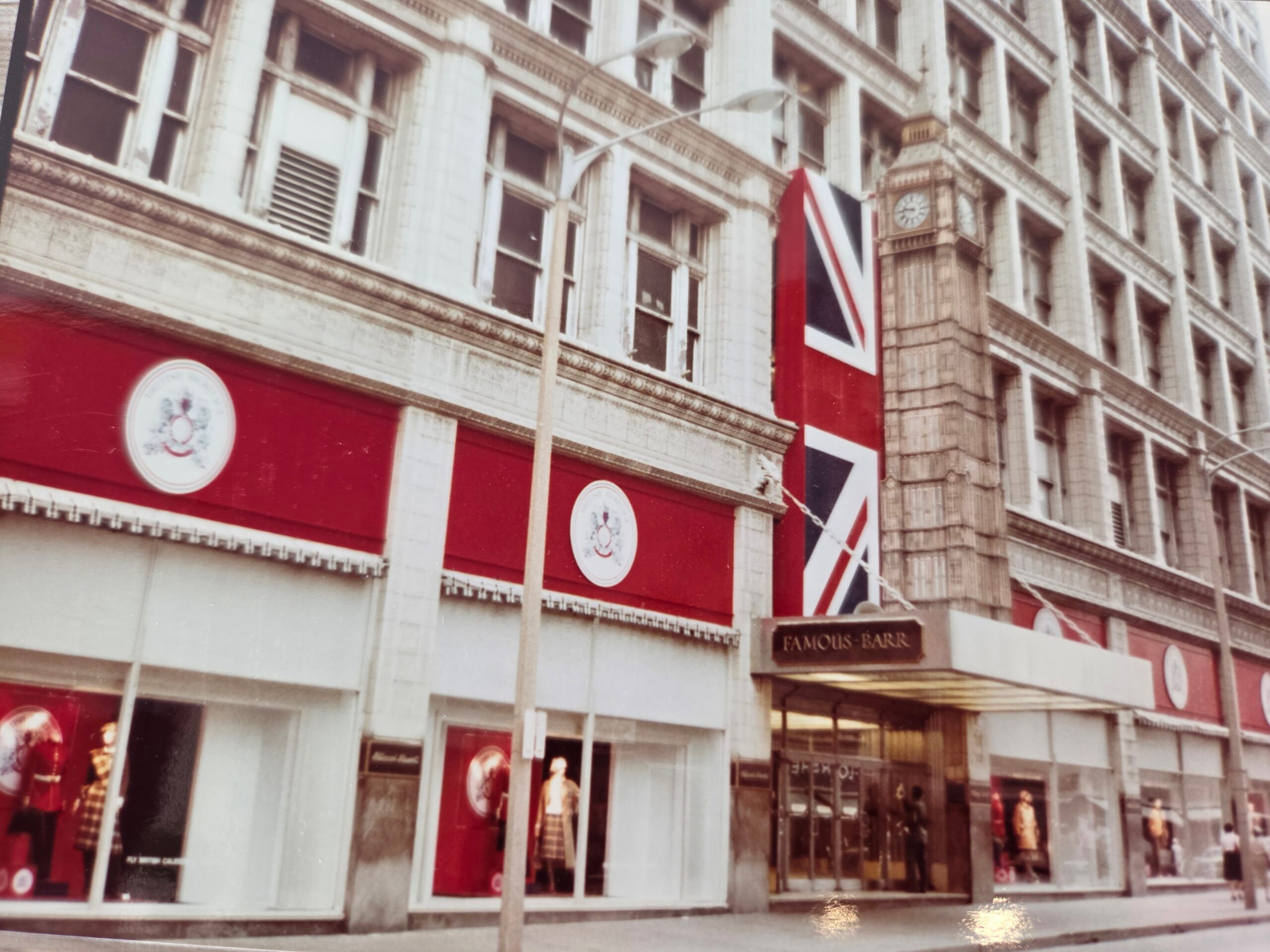
“Hail to the British Commonwealth” was a theme promotion in 1967. Photo courtesy of Terry Lay.
Then, there was Christmas. At Famous-Barr, the season began in September with Trim-A- Home displays before the retailer unveiled its iconic downtown Christmas windows the day before Thanksgiving. “Seventh Street was a fashion bank for most of the year, but for Christmas it morphed into a children’s bank,” Lay recalled. Families by the thousands drove to Downtown to see the animated windows featuring the likes of Mickey Mouse and Snoopy, while inside Santa held court in an elaborately created Santaland on the ninth floor.
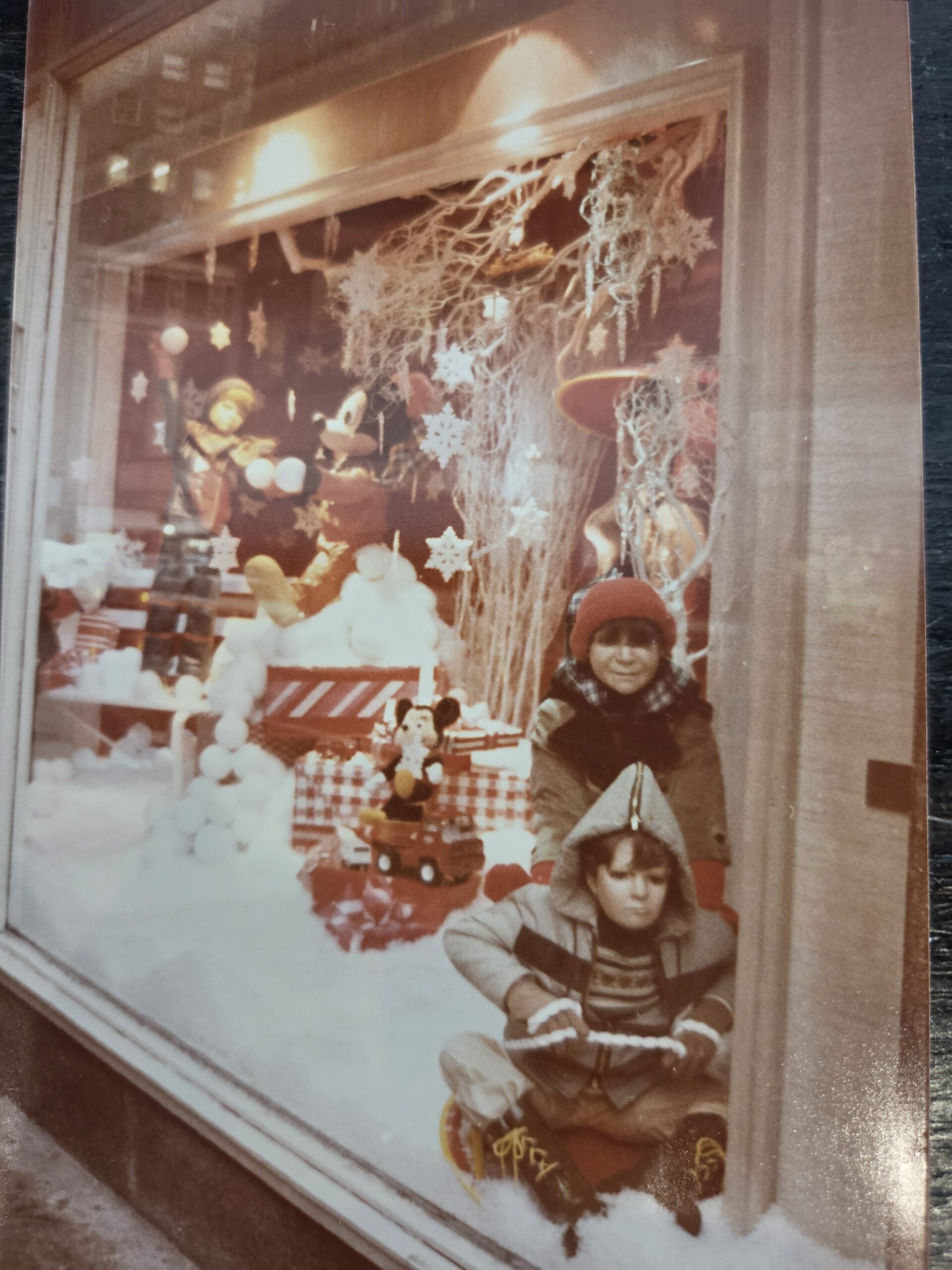
A downtown Famous-Barr Christmas window display. Photo courtesy of Terry Lay.
“It was amazing how many people came just to see the Christmas windows,” Lay said. At the time, Lay remembers being too caught up in the work to recognize his role in shaping the collective memory of downtown St. Louis at Christmastime that so many families from the region share and still talk about today. Looking back, Lay says he’s proud of being a part of that history. “It thrills me now to know that people saw and remembered those things,” he said.
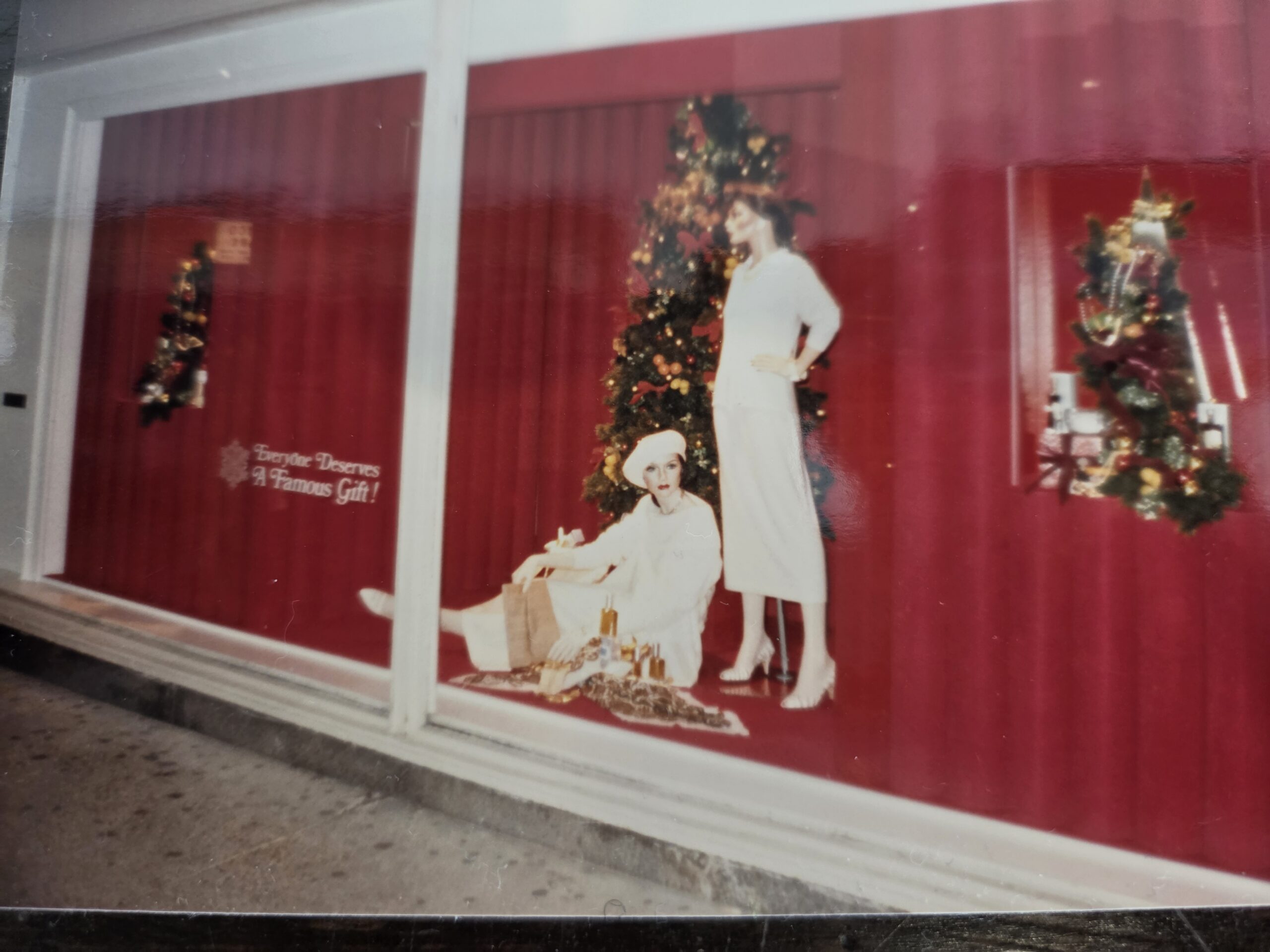
Christmas fashion display at the downtown Famous-Barr. Photo courtesy of Terry Lay.
Lay worked in the downtown store for 13 years before becoming a visual merchandising manager for branch stores throughout St. Louis County. He considers his last Christmas downtown one of his most memorable. That year, due to budget constraints, the display department scaled back its traditional animation and created holiday windows with in-house materials. One featured mannequin children within a forest of candles and signage that read: “Christmas is Candlelight.” Another window was decked entirely in ornaments. “We must have hung 300 ornaments from the ceiling,” Lay recalled. On the floor, children opened boxes dripping in sparkling bulbs. “I thought that was one of the most exciting things.”
In the years that followed, the role of window display as an art form shifted greatly. Street-facing windowfronts diminished during the mall enclosures of the 1980s. In the 1990s, corporate restructuring designed to meet more aggressive bottom-line demands from stockholders took its toll on ambience. “Things that had always been a part of the department store started leaving,” Lay said. That included the book department, the record department, the photo department, and the restaurant. “Anything that wasn’t specifically geared toward the selling of merchandise began to be eliminated, and that also included display people.”
By this time, the term window trimmer had become a vestige of an earlier era. From Northland to Alton to South County to West County to Chesterfield and Crestwood, Lay was by then a visual merchandising manager working alongside increasingly streamlined crews tasked not with making creative window displays, but with hanging ceiling signs for vendor logos and product promotions throughout the store. “There was nothing creative about it,” he said. “It was just something that had to be done.” Window displays, while still a part of merchandising, became simpler.
And yet, despite the changes, Lay says the camaraderie he enjoyed for 42 years at the company was constant and unforgettable. “I loved the people I worked with,” he said. “I still have close friends that I made all those years ago. We were part of what was called The Famous Family.”
After Lay retired in 2008, he turned his talent to watercolor. His subject matter, often depicting bold features of the natural landscape from travels near and far, reflects an interest in archeology and geology that predates his career with Famous-Barr. His dramatic style, however, echoes his years as a display artist: “I like to take a scene and zoom in so that a portion of the scene is magnified nearly to the point of abstraction,” he said.
Lay’s work has been displayed at the Duane Reed Gallery, the St. Louis Watercolor Society, and recently at Heartland Art Club, where he won the David Cornell Award for Composition at the recent Members’ Show. He is also a Signature Member. Lay is currently working on a series depicting rock formations from Elephant Rock State Park in Iron County.
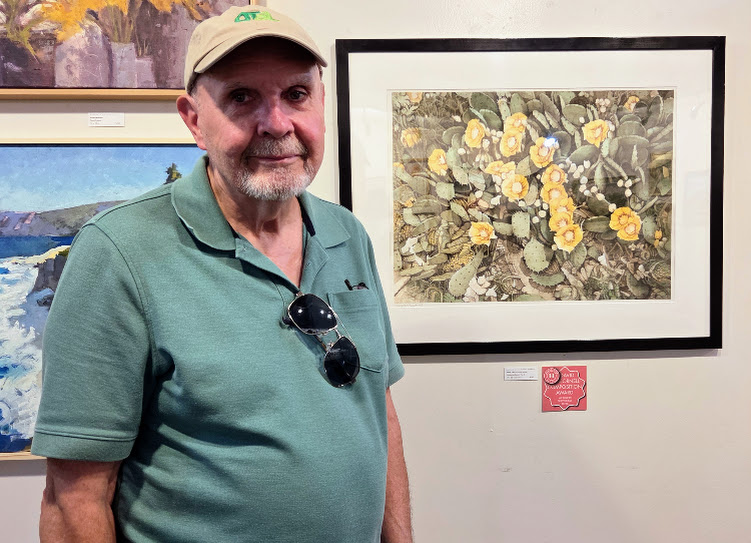
Terry Lay before “Dangerous Beauty,” a recent watercolor inspired by his trip to the American Southwest and painted from his own reference photography. The piece won the David Cornell Award for Composition at this year’s Members’ Show. Lay joined Heartland Art Club this year and is a Signature Member.