
Sarah Sedwick is a Eugene, Oregon-based artist and instructor whose fresh approach to still life painting offers a more modern, contemporary look to the classic painting genre.
By Kara Dicker
Loose Realism is a term that Sarah Sedwick coined initially to describe her painting style. “It simply refers to the result you get when you stop sooner, when you put paint down and leave it alone,” she says. “It’s about bringing the whole painting up together.”
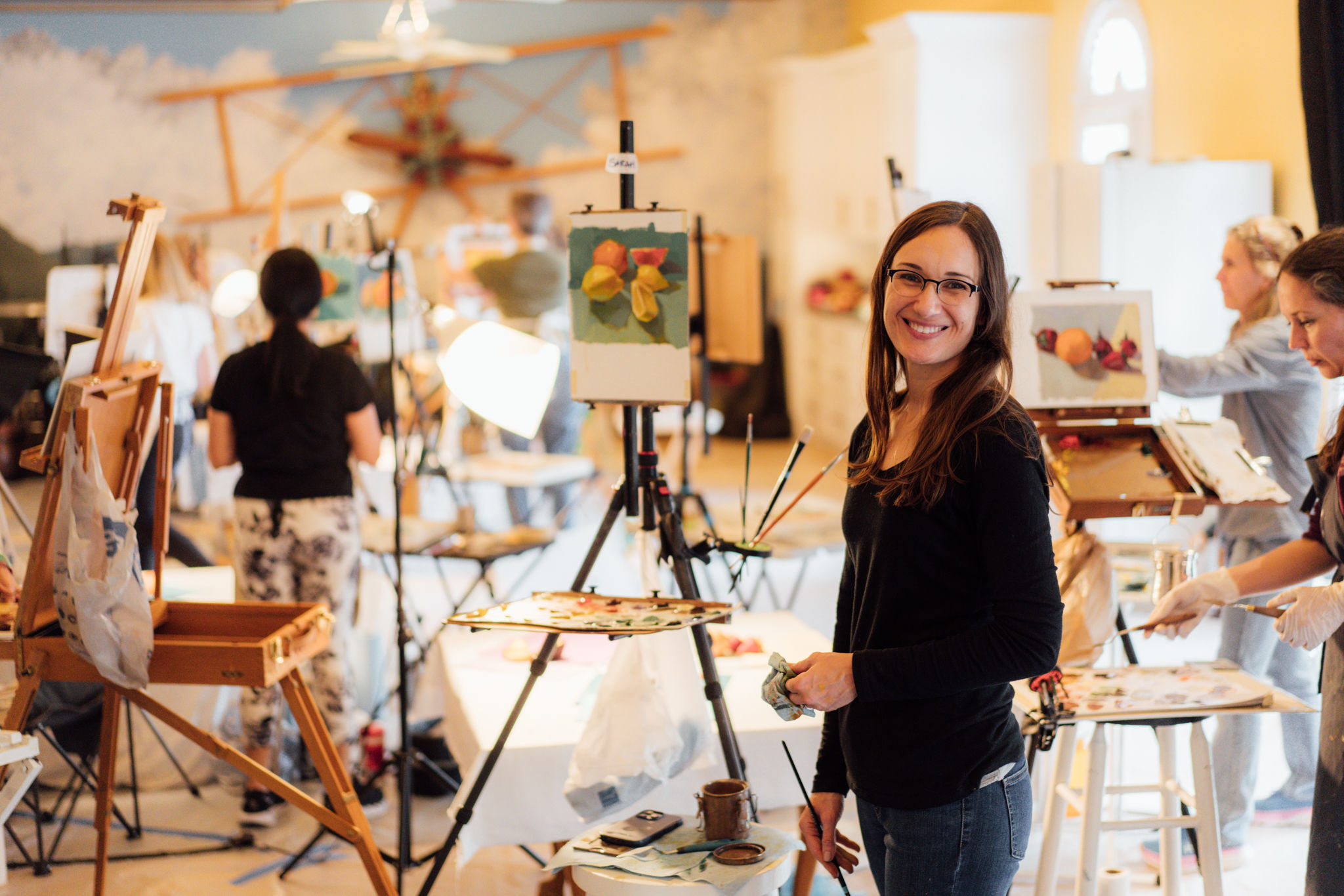
Artist and instructor Sarah Sedwick.
Sedwick is a Eugene, Oregon-based artist and instructor who found her niche in still life painting. From June 26-28, she will be at Heartland Art Club for the Gallery’s first workshop devoted to the still life genre. “Loose Realism, Painting the Still Life in Oils,” delves into techniques behind loose realism in addition to exploring foundational elements of art through direct observation.
“Most painters know how to overwork a painting and kill it to death,” she says. “Most of the artists who come to study with me want to paint looser. Everybody wants to be a looser form of themselves.”
To achieve a looser look, participants will make a lot of starts with the goal of keeping the freshness and energy of application from beginning to end.
“Students can expect to create more paintings with me in a weekend than they’ve made in the last six months,” Sedwick says.
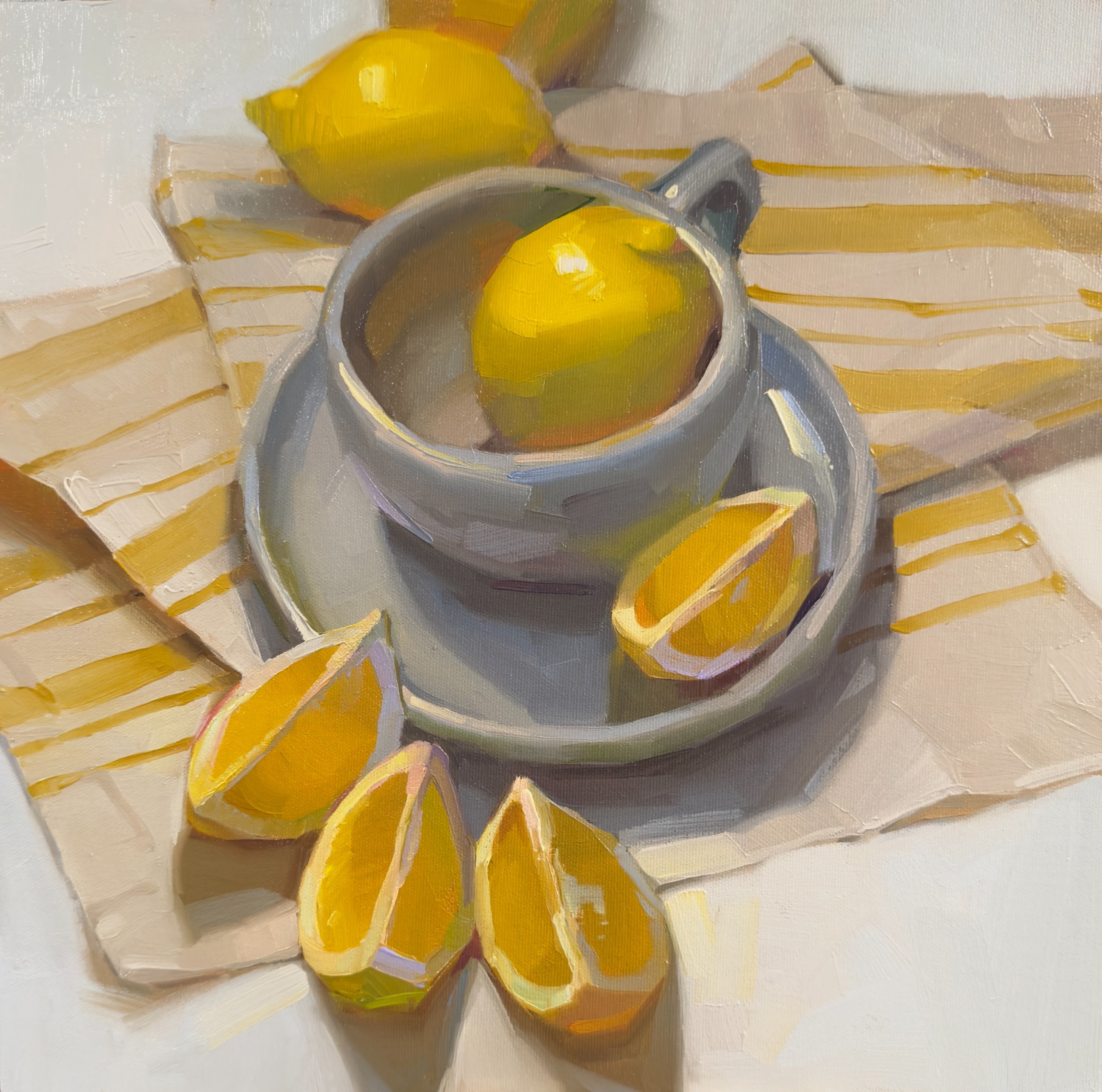
Trending Lemons, by Sarah Sedwick, 10×10, oil.
The outcome of loose realism, she explains, is painting that is realistic and representational, but at the same time contains a level of abstraction, in which the softening or loosening of edges comes into play. “We talk a lot about edges in the workshop,” Sedwick says. “The way you handle your edges has a huge impact on the eventual looseness of your finished painting.”
A nationally and internationally recognized instructor for more than a decade, Sedwick knows how to engage her students and keep the work as fresh and fun as the painting they’re creating. With still life stages set up at each worktable, students work in small groups to benefit from the power of peer support. “Students early in their oil and painting journey paint with people with 20 years of experience,” she says. “They learn from each other.” To keep the pace moving, Sedwick alternates between demonstration and work time. On the final day of the workshop, students will set up a still life of their own.
According to Sedwick, setting up the still life is often the most challenging part. She begins with color and texture combinations. “I’m extremely drawn to certain color combinations. I use them over and over again. We’ve all got our favorite colors to paint; we’ve all got favorite color combinations, and learning what those are is part of the process of growth as an artist.” After finding a color combination that “really sings,” she adds texture combinations to create interest, all the while keeping in mind the values and the lighting that will allow for strong light and shadow patterns.
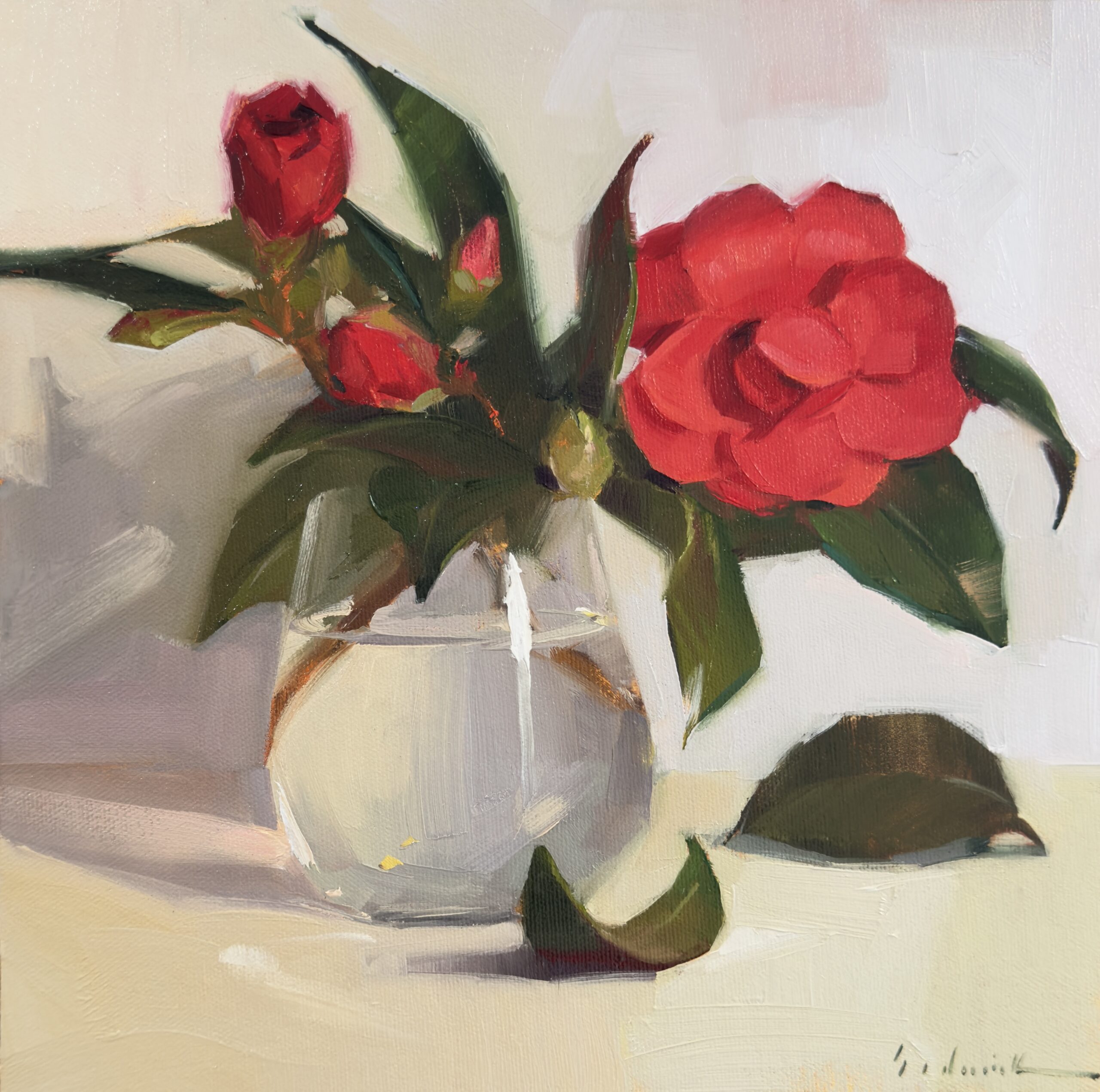
Leap Day Camellias, by Sarah Sedwick, oil.
Sedwick sets up her still lifes to be viewed at a bird’s eye view. “The more contemporary kind of still life, I think, is set apart by vantage point, more than anything,” she explains. “We’ll be standing around a knee-height still life stage and observing from that angle, so that there’s only one plane behind the object.”
As an instructor, Sedwick says that her primary goal for students in her workshop is to develop a level of confidence that will allow them to apply their skills outside of the class. She believes the direct observation inherent in still life painting is an essential part of the confidence-building process.
“Painting from life is a very big value of mine,” she says. While acknowledging that a lot of students are comfortable painting from photo references, Sedwick believes that the practice from direct observation is essential. “That’s what we do in my workshop. I think students gain a lot of confidence when they successfully paint from direct observation.”
Sedwick discovered her love for still life painting not in art school, where she excelled in portraiture and the still life genre was viewed through the traditional hierarchal lens beneath historical, portrait, and landscape painting. Instead, she discovered the “A Painting a Day” movement that took off online in the early aughts. “Daily painting was all about still life painting,” she explains. Founded by American artist and professor Duane Keiser in 2004, the movement offered a philosophical aspect Sedwick found inspiring. “The whole idea that each day was a new start, and that if you had a bad painting day one day that the next day was just going to be something totally else was so liberating to me.”
Today, because of her teaching schedule, plus her attention to larger works that require “the nitty gritty of composition values, and edges, and other details,” Sedwick doesn’t have the time to complete a painting daily. However, she cites the confidence she gained through the practice as invaluable. “Daily painting gave me a carefree feeling around my art process, which is often so hard to discover,” she says. “Many of us are just agonizers.”
In viewing Sedwick’s work, where her fruits and flowers and dishware breathe fresh color and playful texture, it’s easy to understand what inspires her. “It’s a lot like being a food stylist, “she says. “I’m playing with lighting, I’m playing with color combination, I’m playing with themes, although my work tends not to be narrative. My paintings are rarely symbolic. Most of the time they’re just based on something I’ve set up that I thought was beautiful. It’s about conveying beauty out into the world, not necessarily about sending a message.
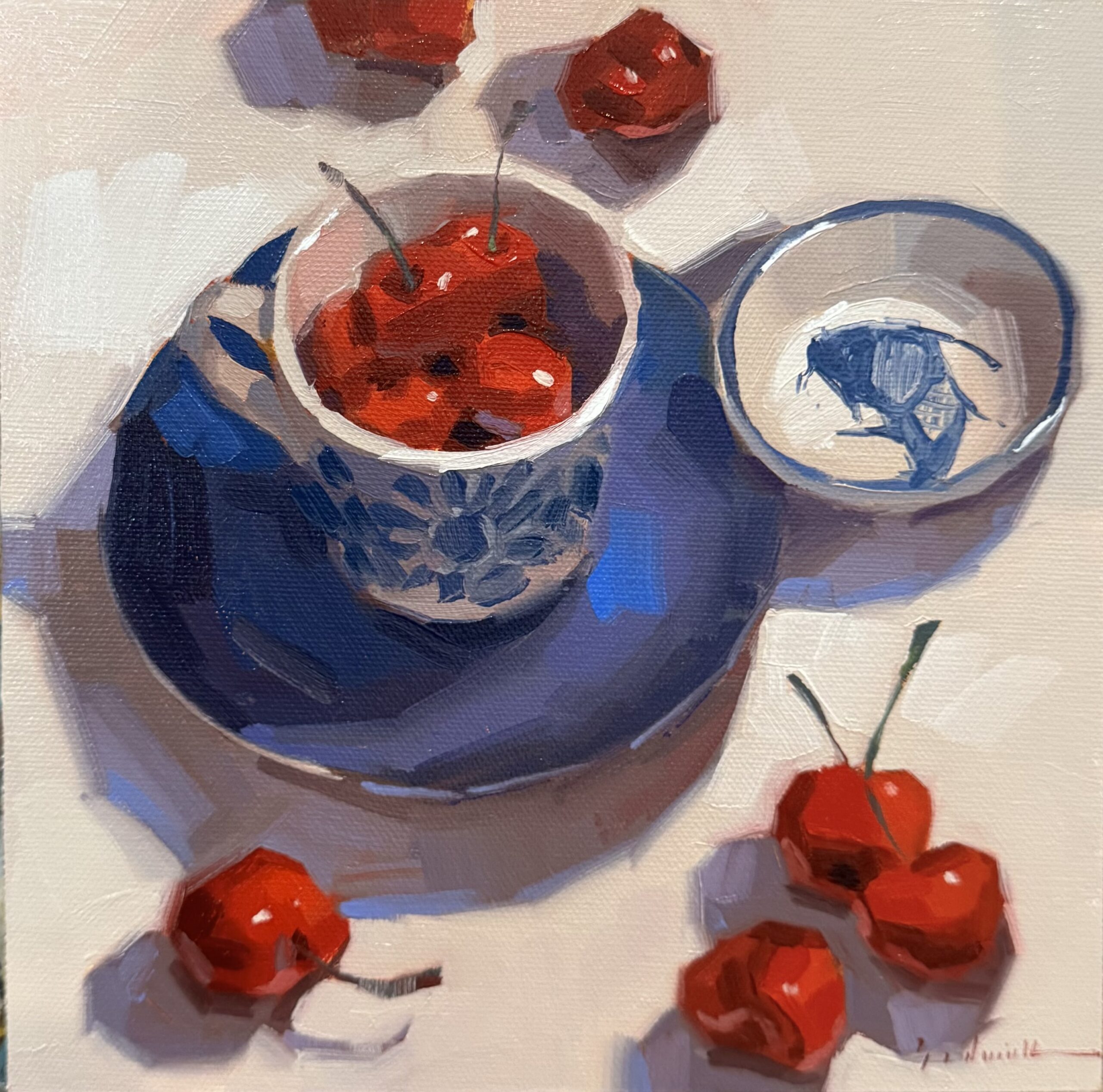
Cherry Demitasse, by Sarah Sedwick, 8×8, oil.